
Nothing ruins a killer pedalboard build faster than unwanted 60-cycle hum, ground loop buzz, or high-pitched digital clock whine. As modern pedalboards evolve to blend delicate vintage analog overdrive circuits with high-draw digital DSP reverbs, pitch-shifters, and delay processors, feeding your board clean, true isolated power is non-negotiable.
We sat down with Trey Hawkins at The Guitar Sanctuary to walk through a step-by-step, real-world customer consultation. Whether you are running a grab-and-go fly rig or an expansive 12-pedal studio board, here is how to eliminate noise, match your milliamp (mA) draw, and select the perfect isolated power supply.
The In-Store Consultation: Step-by-Step with Trey Hawkins
Step 1: Diagnosing Pedalboard Noise & The Ground Loop Problem
Customer: "Hey Trey! I've been expanding my pedalboard recently—adding a couple of digital delay and reverb units alongside my favorite dirt pedals—and now my rig is making this awful high-pitched electrical whine and constant buzz through my amp. What's going on here?"
Trey Hawkins: "First off, welcome in! What you're hearing is one of the most common issues players run into as their board grows. The very first question I ask anyone dealing with that kind of noise is: Are you daisy-chaining your pedals off a single wall adapter, or are you using a true isolated power supply?"
Customer: "Right now I'm just running a 9-volt daisy-chain cable plugged into one wall outlet."
Trey Hawkins: "That’s the exact culprit 90% of the time. When you daisy-chain, every pedal on that line shares a common ground path. Digital DSP pedals (like modern reverbs, delays, and pitch-shifters) dump high-frequency digital clock noise directly into that shared ground wire. Your sensitive analog pedals—like a fuzz, overdrive, or wah—pick up that ground noise and amplify it straight to your amp.
An isolated power supply eliminates that completely. Each output port on an isolated supply has its own dedicated transformer winding and isolated ground circuit. It’s the electrical equivalent of giving every pedal its own separate wall outlet and its own clean power transformer."
Step 2: Demystifying Volts (V) vs. Milliamps (mA)
Customer: "Okay, that makes sense. But when I look at power supply specs, all the numbers get confusing. What's the difference between Volts and Milliamps, and how do I calculate what my board needs?"
Trey Hawkins: "It’s easier to manage if you break it down into two basic rules:
- Voltage (V) is the 'Pressure': You must MATCH the exact voltage specified by the pedal manufacturer (typically 9V DC center-negative). Some drive pedals sound more dynamic at 18V due to increased headroom, but never give a 9V-only pedal 12V or 18V unless the manual explicitly states it can handle it, or you risk destroying the internal circuit.
- Current / Milliamps (mA) is the 'Capacity': Think of milliamps as the size of your gas tank. A pedal only draws the current it needs. If your digital delay requires 300mA and you plug it into a 500mA port, that's completely safe—the pedal takes 300mA and leaves 200mA in reserve. However, if you plug a 300mA digital pedal into a 100mA port, the pedal either won't turn on or it will glitch out during performance.
Trey's Current Draw Rule of Thumb:
• Analog Pedals (Overdrives, Fuzzes, Tuners, Wahs) draw minimal power—often just 10mA to 50mA.
• Digital Pedals (Strymon DSP, Eventide, Line 6, Digital Delays) are high-draw units requiring anywhere from 200mA to 500mA+ per tap.
Step 3: Calculating Power for a 12-Pedal Hybrid Board
Customer: "So let's take my exact setup. I've got 12 pedals on my board. Four of them are high-draw digital DSP units—a Strymon BigSky (300mA), Strymon Timeline (300mA), Eventide H9 Max (500mA), and an EHX Pitch Fork (30mA). The other eight are analog dirt, fuzz, and utility pedals like my Klon KTR, Tube Screamer, King of Tone, Analogman Sun Face Fuzz, EP Booster, Cry Baby Wah, Boss Tuner, and Empress Tremolo. How do we power a hybrid board like this?"
Trey Hawkins: "You’ve got an incredible lineup of tone on that board! But electrically, those 4 digital pedals require 1,130mA by themselves, while your 8 analog pedals only pull about 125mA combined. When those share ground paths, that 1,130mA digital clock signal screams directly through your Germanium fuzz and overdrive circuits.
To handle 12 pedals like this cleanly, we look at the prominent power supply lines we stock at the Sanctuary:
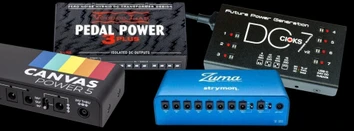
- Cioks (e.g., Cioks DC7 + Cioks 8 Expander): The ultimate modular, low-profile setup. The DC7 links directly to the Cioks 8 expander via a single 24V pass-through cable, giving you 15 isolated outputs off one wall plug. Every single port delivers a massive 660mA at 9V (or toggleable to 12V, 15V, or 18V), giving your digital pedals endless headroom while allowing you to run drive pedals like your King of Tone or EP Booster at 18V with the flick of a switch.
- Voodoo Lab (e.g., Pedal Power 3 Plus): The single-unit heavyweight. Features 12 isolated outputs, each pushing 500mA at 9V DC. It handles all 4 of your digital power hogs on dedicated 500mA taps with zero noise, while feeding your analog pedals on the remaining ports. Plus, it includes X-LINK expansion ports to easily chain additional Voodoo Lab X4 or X8 modules as your board expands.
- Strymon (e.g., Zuma & Ojai): Built specifically for high-current digital rigs. The Zuma delivers 500mA at 9V across 9 isolated taps with dual-stage isolation, making it dead-silent, ultra-lightweight, and exceptionally efficient.
- Walrus Audio (e.g., Canvas Power & Phoenix): Delivers high port density and modern modular flexibility. The Canvas Power series offers ultra-clean power with variable voltage options in a clean, modern aesthetic.
Step 4: Under-Board Mounting & Cable Security
Customer: "I'm building this on a Pedaltrain Classic 2 frame, and mounting under the board is an absolute dealbreaker for me. I don't want to waste top-deck space on a power supply. Which option mounts cleanest under a Pedaltrain?"
Trey Hawkins: "Between the options, the Cioks DC7 + Expander is the clear winner for under-board Pedaltrain and Temple Audio mounting for two major reasons:
- 1-Inch Ultra-Slim Profile: The Cioks DC7 is exactly 1.0 inch thin (25.4mm). It glides underneath any Pedaltrain frame—even low-profile Nano and Metro boards—without requiring taller rubber feet or frame modifications.
- Threaded RCA Locking Connectors: Standard 2.1mm barrel plugs can slowly wiggle loose underneath your board during transport or gigging. Cioks uses snap-locking threaded RCA connectors on the supply side. Once plugged in, they are mechanically locked down and will never vibrate loose on the road.
Plus, with the drill-less Cioks GRIP Bracket, you can clamp the DC7 directly onto your Pedaltrain rails in about 30 seconds without drilling a single hole."
Summary: Trey's 3-Step Power Supply Checklist
Before buying a power supply for your rig, run through these three steps:
- Count Your Outlets: Ensure you have enough isolated outputs for every pedal currently on your board, plus 1 or 2 extra taps for future additions.
- Tally Your Current Draw (mA): Identify your high-draw digital DSP pedals (200mA–500mA+) and verify that your supply offers dedicated high-current taps for those ports.
- Check Under-Board Clearance: Measure the physical height under your pedalboard frame to select an ultra-slim supply (like Cioks) if space is tight.
Pedalboard Power Supply Quick Reference
| Brand & Model | Isolated Taps | Max mA Output | Selectable Voltage | Best For |
|---|---|---|---|---|
| Cioks DC7 | 7 (Expandable) | 660mA @ 9V | 9V / 12V / 15V / 18V (All Taps) | Ultra-slim under-board mounting & RCA locking cable security |
| Strymon Zuma | 9 | 500mA @ 9V | 9V / 12V / 18V (2 Taps) | Dead-silent, high-current supply ideal for DSP-heavy rigs |
| Voodoo Lab Pedal Power 3 Plus | 12 | 500mA @ 9V | 9V / 12V (2 Taps) | High port count & seamless X-LINK expansion capability |
| Walrus Audio Canvas Power 8 | 8 | 500mA @ 9V | 9V / 12V / 18V (2 Taps) | Modern modular power & sleek under-board integration |
Ready to Eliminate Noise and Power Your Rig?
Whether you need a compact power unit for a grab-and-go board or an expandable isolated system for a massive studio rig, we carry the complete lineup in stock at The Guitar Sanctuary.
Have questions about your board's specific voltage or milliamp needs? Visit our showroom in McKinney, TX, or explore our full collection online today!

